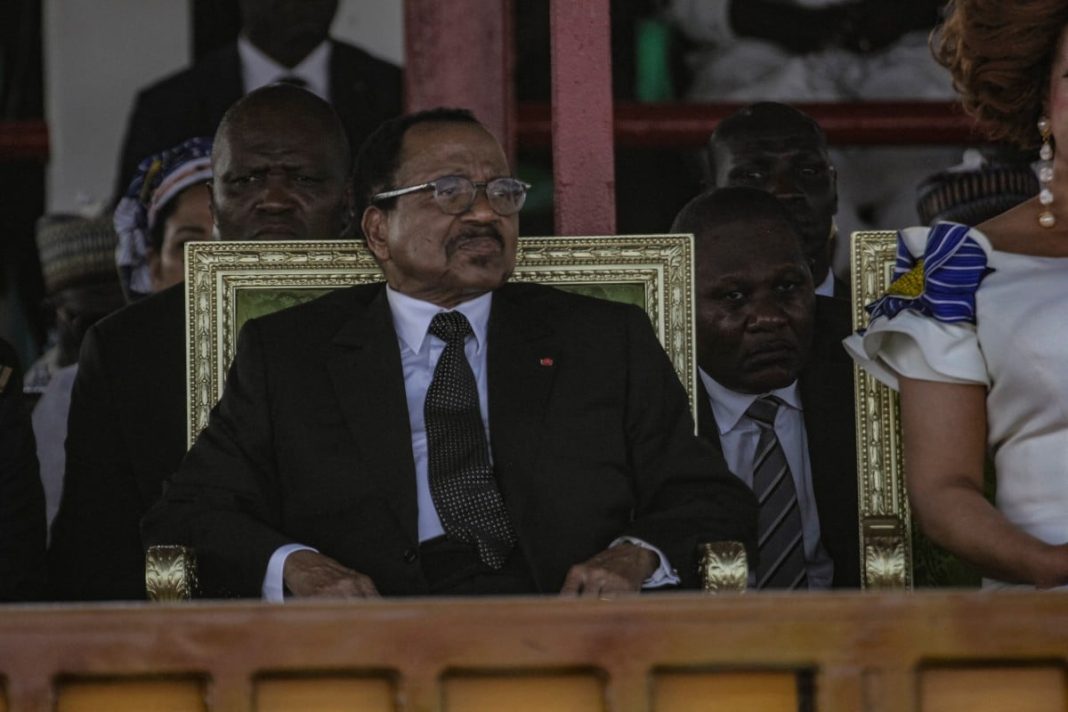
Cameroon’s Paul Biya, already the world’s oldest head of state, is the favourite to win Sunday’s presidential election, handing him an eighth term in power in the central African country.
A fractured opposition of 11 candidates is standing against the 92-year-old in the vote, whose credibility and fairness rights groups have called into question.
Most of the 7.8 million Cameroonians called to the ballot box can remember no leader other than Biya, who has held onto power with an iron fist since 1982.
Questions over the state of his health have only grown louder since he entered his 10th decade. Should Biya win, he would be nearly 100 by the end of his eighth term.
Though the opposition hopes to entice voters with promises of a new face and an end to the cost-of-living frustrations of the long Biya epoch, its most credible candidate, Maurice Kamto, had his candidacy barred by the courts.
Theophile, an artist in the economic capital Douala, branded the vote a “scam”.
The 24-year-old had hoped to vote for Kamto, who came second to Biya in the 2018 election.
“As long as the system remains in place, there is nothing that can be done. There has to be a change,” he told AFP.
Others value the veteran’s decades of experience in a country where half the population is under the age of 20.
“I say Paul Biya still has something to offer,” said Giovanni, a 20-year-old student in Douala.
“Even though some of his promises haven’t been kept, I’m counting on him. He’s a wise man with a wealth of experience and a long track record.”
– ‘Determination intact’ –
The longtime president was noticeably absent from the campaign trail.
He had taken a trip this month to Switzerland, his favoured destination for overseas jaunts, fuelling fresh speculation over the state of his health.
But he made a rare outing on Tuesday, holding a rally at a stadium in the town of Maroua in the Far North region, a key electoral battleground with 1.2 million registered voters.
It was his first public appearance since May.
“My determination to serve you remains intact,” he told the crowd in a 25-minute speech, which touched on youth, women and infrastructure.
Though his entourage expected nearly 25,000 people at the event, AFP reporters present estimated only a few hundred showed up.Related News
- Bakassi: Unending narrative of diplomatic intrigues, oil revenue controversies
- Africa must prioritise investment in telecoms infrastructure, says Ndukwe
- Energy, talent gaps threaten Africa’s digital growth – Experts
Biya became Cameroon’s second president since independence in the 1960s in the 1984 election, when he ran unopposed and won 100 per cent of the vote.
He had already taken over two years earlier when his predecessor Ahmadou Ahidjo resigned suddenly.
He was re-elected in similar style in 1988 but after the introduction of multi-party politics only narrowly overcame challenger John Fru Ndi in 1992 by a four-per cent margin.
Biya turned to a mix of repression, regional alliances and overtures to his former rivals to curtail threats to his rule, Arrey Ntui, the International Crisis Group’s senior analyst for Cameroon, said.
His strategy bore fruit: he was re-elected with 93 per cent of the vote in 1997, 71 per cent in 2004, 78 per cent in 2011 and 71 per cent in 2018.
– ‘Protect the vote’ –
Human rights groups have spent years condemning Biya’s stranglehold on Cameroon’s institutions and election process.
“The electoral charade is unlikely to signal any potential change in the immediate future but rather the consolidation of the status quo,” said David Kiwuwa, who heads the School of International Studies at Nottingham University’s campus in China.
With four-in-10 Cameroonians living under the poverty line in 2024, according to the World Bank, economic fears have long loomed large in voters’ minds.
The high cost of living, as well as the lack of drinking water, quality schooling and healthcare, have long frustrated Cameroonians.
“I keep hoping for a better Cameroon where young people can find work,” Boris, a computer engineer in the coastal city of Buea, told AFP.
“I imagine a day when Cameroon looks like Paris, with accessible and affordable education, where we can drive safely on our roads.”
Yet those recurring complaints, widely shared on social media, have not led people to take to the streets in protest.
Several citizens’ associations have set up networks of observers at polling stations to “protect the vote” by counting ballots independently.
The government has slammed these as attempts to “manipulate public opinion” and “produce skewed results”.
The vote will be held in the shadow of a deadly conflict between separatist forces in Cameroon’s English-speaking regions and the government.
During the last vote in 2018, turnout was particularly low in anglophone Cameroon, where the fighting is fiercest.