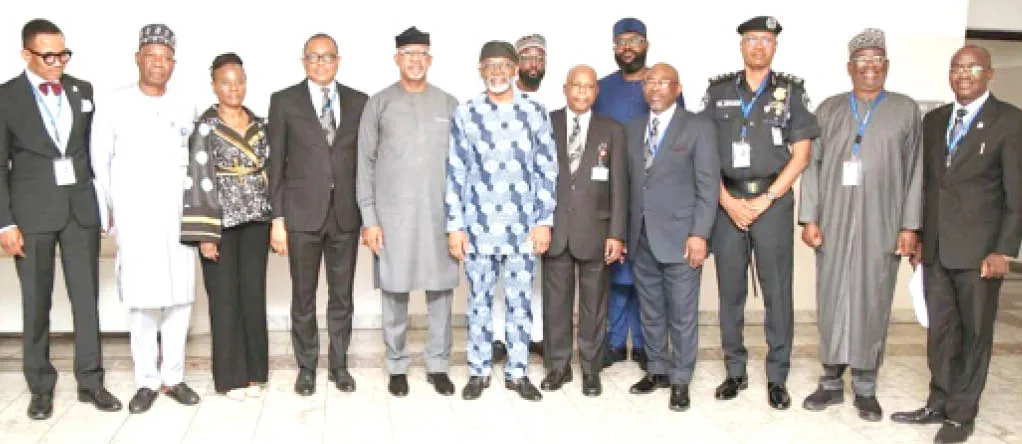
The Presidential Working Group on the National Policing Bill has promised to submit an executive bill to President Bola Ahmed Tinubu on September 3 as part of the ongoing efforts to establish the legal and operational framework for the proposed state police across the country.
Speaking yesterday after the inaugural meeting of the presidential working group at the State House, Abuja, the chairman of the committee and Chief of Staff to the President, Femi Gbajabiamila, said the package would go beyond draft legislation and provide the implementation blueprint required to operationalise a dual federal-state policing architecture once the constitutional amendment creating state police comes into force.
“The resulting executive bill package is scheduled for presentation to the president on the 3rd of September. We have tweaked the process so that the national consultation will come before the president’s final approval, after which the text and supporting materials will be revised and prepared for formal transmission to the National Assembly”, he said.
The Chief of Staff described the exercise as one of the country’s most significant governance reforms, saying it was aimed at creating “a lawful, professional and sustainable federal and state policing system that places greater capability closer to the people while preserving national standards, national security and the rights of every Nigerian.”
“The constitutional amendment is not yet in force. Until that process is concluded and the necessary implementing laws are enacted, there is no operational state police service anywhere in Nigeria, and the Nigeria Police Force remains the constitutionally recognised police institution.
“Our mandate is to produce a technically robust, implementation-ready draft National Policing Bill and supporting legislative package. We are building the legal and operational framework required to move from one federal police institution to a workable dual policing architecture”, he said.

He said the assignment also includes a review of the Police Act 2020, the Police Service Commission framework, police regulations and other laws affected by the reform, alongside provisions for minimum national policing standards, state certification, interstate cooperation, independent complaints institutions, human rights safeguards, forensic systems, funding arrangements and transition plans.
Gbajabiamila said Tinubu had approved a multidisciplinary Policy Advisory Committee chaired by Justice Mohammed Abdullahi Liman to provide technical oversight and validate the bill, fiscal framework and implementation materials before executive consideration.
The committee, he noted, draws membership from the judiciary, academia, security agencies, the National Assembly, the Office of the National Security Adviser, the Nigeria Police Force, the Nigerian Bar Association, the Nigeria Governors’ Forum and state Attorneys-General representing the six geopolitical zones.
He said the seven-week work programme, running from July 27 to September 14, would proceed through simultaneous legal drafting, policy research, data analysis and implementation modelling.
The final submission, he said, will include schedules, an explanatory memorandum, legal audit, consequential amendments matrix, clause-by-clause analysis, state readiness framework, fiscal and implementation notes, validation report, risk register and a digital archive.
The Chief of Staff said the government remained committed to ensuring that decentralised policing would not undermine national unity or the rule of law.
He added that while states must have a legitimate role in public safety, “no political office holder should be able to direct the arrest of an opponent, the suppression of lawful political activity or the selective enforcement of the law”.
He further explained that federal intervention would remain “exceptional, evidence-based, proportionate, time-limited and reviewable”, while officers would remain accountable to the Constitution rather than political interests.
Gbajabiamila also said no state would be permitted to commence policing operations until it demonstrates readiness in recruitment, training, equipment, pensions, complaints handling, financial sustainability, firearms control and independent oversight.
“Operational commencement must be based on readiness, not announcement”, he said, adding that although states could exceed national benchmarks, “no Nigerian should receive a lower standard of protection because of where they reside”.
To encourage public participation, he announced an open call for memoranda and position papers from Nigerians, civil society organisations, professional bodies, security institutions and other stakeholders.
He disclosed that a dedicated portal, nationalpolicingbill.com, had gone live to receive submissions, with plans for migration to a government domain.

“The whole idea behind state policing is for you and I and everybody out there to take ownership. No matter your station in life, you have an opportunity to contribute meaningfully”, he said.
Answering questions on the financial scale of the reform, Gbajabiamila said it was premature to estimate costs, noting that expenditure would be determined through empirical research conducted on a state-by-state basis.
“There is no cost that will be too much to secure lives and property. But giving you a figure now would be pulling something out of thin air. The cost will be evidence-based and based on thorough research,” he said.
He also dismissed fears that some states might lack the capacity to establish police services, insisting that every state possesses some level of capability.
“The federal police remains in place until such a time when the state is able to come on board with the state police”, he said.
Also speaking, the Attorney-General of the Federation and Minister of Justice, Lateef Fagbemi, said the primary objective of the proposed legislation was to strengthen the protection of lives and property while ensuring that state police could never become instruments of political persecution.
He explained that where any state was not yet prepared to establish its own police service, the Nigeria Police Force would continue to provide policing until such capacity was developed.
“Law abhors a vacuum, so the federal presence will continue to dominate in that area”, Fagbemi said.
He defended the proposed minimum national policing standards, saying they were essential to guarantee equal protection for Nigerians irrespective of where they resided.
“The main thrust of this bill is to ensure security of lives and property, and it is also important that we do not make state policing a weapon of political persecution or oppression.
“There must be standards. There must be the minimum threshold to guarantee the continued existence and operation of society”, he said.
He said the standards would be aligned with globally recognised policing practices and ensure that officers moving between the federal and state police services would not lose their benefits.
Ogun State Governor Dapo Abiodun said the legislation would provide the legal and operational framework needed to translate Nigeria’s constitutional amendment on state police into a workable policing system.
Abiodun, who represents the Nigeria Governors’ Forum on the Presidential Working Group on the National Policing Bill, said the bill would address critical issues, including the jurisdiction of federal and state police, funding arrangements, recruitment, startup grants for states and amendments to existing laws affected by the reform.
“What we’ve seen and witnessed is the amendment of the Constitution, and we’ve seen a groundswell of support by the entirety of Nigerians with a very high level of expectation that once the amendment was completed by the National Assembly, the next thing is for states to begin to implement their various state policing systems.
“The truth is that what this working group is working on is what would allow for the details of that implementation, which will be reflected in the bill”, he said.
Abiodun dismissed suggestions that the Federal Government was attempting to retain control over state policing through the proposed legislation, saying the bill was intended only to translate the constitutional amendment into an effective and workable legal framework.
“Where do the powers of the federal police stop? Where do the powers of the state police start? Some states may not have as much capacity as others. Of course, they will recruit as many policemen as they want in their state, and I’m sure part of what we are doing will also recommend some form of grant from the federal to ensure a startup”, he said.