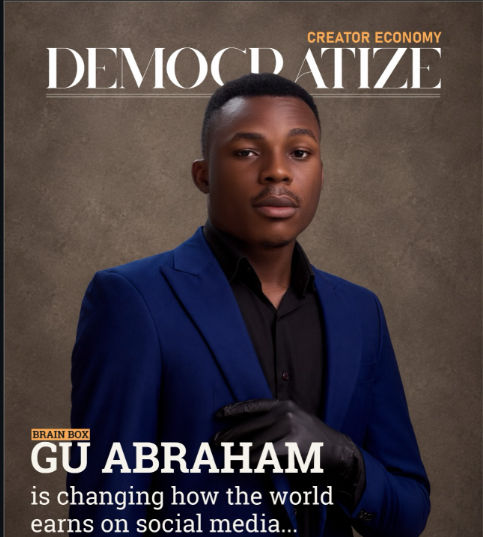
The pitch sounds nice Social media was never really about likes, it was about distribution. And whoever turns that distribution into a real business “owns the next chapter.” That’s the bet GU Abraham is making with his new venture, Xilolo, which he says will decentralize how creators earn money.
G.U Abraham is a visionary Nigerian tech founder and entrepreneur, best known as the founder of Xilolo, a creator-economy platform, Abraham’s journey so far is that of a founder who turned a clear critique of the creator economy into a product, a bet that the future belongs to creators who own their audience, rather than rent it from a feed. Abraham emerged in the public eye as a sharp, plainspoken voice on the creator economy. His central message is that most content creators remain broke not for lack of talent, but because their income is tied to platform algorithms rather than to the people who actually follow them. A follower, he argues, is not a customer and millions of views can still leave a creator with an empty bank account.
Is the idea itself visionary? Honestly, the diagnosis is correct. Look around, the creators still standing today are not the ones who went viral once and disappeared. They’re the ones who built something they actually own; an email list, a community, a product, a way to get paid that doesn’t depend on one app’s mood that morning. Because we all know how it goes, you wake up one day, the algorithm has changed its mind about you, and just like that, your reach is gone with no explanation, no apology, nothing. So the idea that “likes” alone were never the real business has always been true. GU Abraham isn’t discovering fire here, but he’s pointing at the right fire.
Right now, a small number of platforms basically decide who gets paid, how much and when the rules changes without a prior memo. If Xilolo genuinely gives creators independent, portable ownership over how they make money, that’s not just a nice app, that’s shifting real power away from the gatekeepers. That’s the difference between “another creator tool” and an actual new chapter.
But here’s what to watch closely, because “decentralize” is one of those words people love to use the way people casually say “I’ll call you back”, it sounds sincere in the moment. First, does it actually remove the middleman, or does it just become a new middleman with nicer branding? Second, can a creator leave with their audience and their money intact, or are they still quietly stuck? Third, and this is the one that matters most, who ends up holding the power once it succeeds? A lot of “decentralization” stories in this space have a funny way of ending with one new king sitting on the same old throne.
So the honest opinion is that, the idea is a solid solution to the creator economy. The instinct behind Xilolo is one of the smarter reads on where the creator economy is actually headed. Whether it earns the word “visionary” depends on one thing only whether it hands creators real independence or just gives them a shinier chain.